Cimabue Cenni di Peppi
'the father of Italian painting’
1240-1302
Italian Byzantine Style Painter
Artistically and Stylistically Influenced by the following Painters and Art Movements: - Coppo di Marcovaldo, the Carolingian Style and Classical Greek Art
Education - apprenticed at age 10 to local Greek icon makers and later a gold smith
Medium - Tempera on wood
Cause of death - plague
Artistically and Stylistically Influenced by the following Painters and : - Coppo di Marcovaldo
Education - apprenticed at age 10 to local Greek icon makers and later a gold smith
Medium - Tempera on wood
Cause of death - bloody flux compounded by an advanced age. He is buried in the Church of Santa Maria del Fiore ( Cathedral of Florence) inscribed on his tomb: “Cimabue thought himself master of the field of painting. While living, he was so. Now he holds his place among the stars of heaven.”
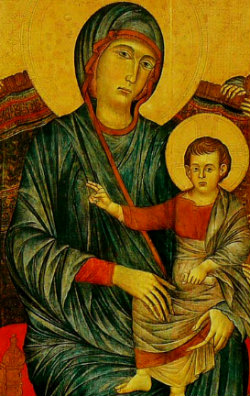
Cimabue is best known for his poetically conceived, graceful, contemplative Madonnas. His holy figures are seemingly detached from the world in silent contemplation. The painter was Intent on mesmerizing and enlightening the viewer with the ethereal beauty of his work. Eminent art historian and author, John C. Van Dyke explains "Cimabue seems the most notable instance in early times of a Byzantine-educated painter who improved upon the traditions. He has been called the father of Italian painting, but Italian painting had no father. Cimabue was simply a man of more originality and ability than his contemporaries, and departed further from the art teachings of the time without decidedly opposing them. He retained the Byzantine pattern, but loosened the lines of drapery somewhat, turned the head to one side, infused the figure with a little appearance of life. His contemporaries elsewhere in Italy were doing the same thing, and none of them was any more than a link in the progressive chain."
Not until the thirteenth century, in the works of Florentine master Cimabue, is a change in religious painting perceptible. The Christ-child becomes more childish and tender; and a soft inclination of the head of the Madonna shows that she hears the prayers of men and can bring help and gracious forgiveness. The hard, sullen features are animated by softness and charm, by human sentiment; and it is in this sense that Vasari wrote that through Cimabue more love had come into art.
According to art historian
Clara Erskine Clement "The Cimabui were a noble family, and
Giovanni was allowed to follow his own taste, and became a painter; he
was also skilled in mosaic work, and during the last years of his life
held the office of master of the mosaic workers in the Cathedral of
Pisa, where some of his own mosaics still remain.
Of his wall-paintings I shall say nothing except to tell you that the
finest are in the Upper Church at Assisi, where one sees the first step
in the development of the art of Tuscany. But I wish to tell the story
of one of his panel pictures, which is very interesting. It is now in
the Rucellai Chapel of the Church of Santa Maria Novella, in Florence,
and it is only just in me to say that if one of my readers walked
through that church and did not know about this picture, it is doubtful
if he would stop to look at it—certainly he would not admire it. The
story is that when Cimabue was about thirty years old he was busy in
painting this picture of the Madonna Enthroned, and he would not allow
any one to see what he was doing."
Cimabue was a gloomy genius. He painted with passion and naturalism, thus building the groundwork for the Renaissance. He aspired to reawaken the divine spirit of holy figures rather than depict their physical qualities. He was influenced by Coppo di Marcovaldo yet forged his own unique style within the tradition of religious Byzantine painting. The mysticism in his work is apparent as he conveys a profound awareness of his fellow man.
He maintained an industrious
studio and mentored many your artists including
Giotto.
He was known for his generosity with the local vagabonds and stray
cats. Often allowing lepers and beggars to stay in his stables and
adjacent out buildings. At one time he is said to have cared for 33
cats. Cimabue died in the year of 1302.
Few of Cimabue's paintings or mosaics are to be
found. Artists of the Middle Ages typically were so traumatized
by stories of torture, persecution and death during
the
Iconoclast that they did not even sign their works. This
makes it hard to identify many medieval art-works.
| Byzantine 500-1450 | Romanesque 950-1250 | ||||||||||
| Gothic 1150-1580 | Florentine | ||||||||||
| Sienese School 1150-1550 | Venetian | ||||||||||
| Early Renaissance 1350-1500 | |||||||||||
| High Renaissance 1450-1530 | |||||||||||
| Northern Renaissance 1350-1600 | |||||||||||
| Mannerism 1510-1600 | |||||||||||
| Baroque 1600-1750 | |||||||||||
| Rococo 1710-1790 | |||||||||||
| Neoclassical 1740-1835 | |||||||||||
| Romanticism 1750-1860 | |||||||||||
| Hudson River School 1825-1880 | |||||||||||
| Orientalism 1800-1885 | |||||||||||
| Academic Classicism 1865-1920 | |||||||||||
| Victorian Classicism 1845-1895 | |||||||||||
| Pre-Raphaelite 1840-1855 | |||||||||||
Impressionism
1860-1895
|
Require more information about Cimabue in Art History? Type your query in art into the google search box below and poke around every nook and cranny of the known universe for information this subject.
Do you know something we don't? If you have comment or would like to share an insight regarding Cimabue in Art History, please submit your comment to the editor, via e-mail and if possible site the source. Thank you!
© HistoryofPainters.com If you like this page and wish to share it, you
are welcome to link to it, with our thanks.
| links | artist biographies | top 50 painters | art supplies | book store |
| site map | art movements | artist quotations | iconography | 100 greatest paintings |