Search:: Artists Alphabetically Artists by Country Artists by Century Artists by Movement
Julian Alden Weir
1852-1919
American Impressionist Tonalist Painter and founding member of the Ten American Painters
Stylistically influenced by the following painters and movements - Impressionism, Japanese Prints, Claude Monet John Henry Twachtman, Jules Bastien-Lepage, Robert Swain Gifford and James Abbott McNeill Whistler
Education - studied at the National Academy of Design in the United States and later at the prestigious Ecole des Beaux-Arts in Paris, France under Jean Leon Gerome
Cause of Death - Old Age
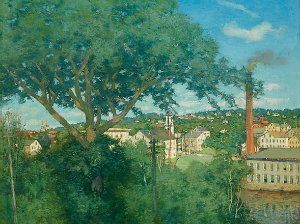
Description of the Julian Alden Weir's Tonalist and Impressionist Painting Style and Technique
Julian Alden Weir was born into a family of notable nineteenth-century painters. Instructed at first by his demanding father, and later at painting academes at home and abroad. The artist was a master at depicting the natural environment. His Connecticut landscapes richly record the changing of the seasons, with spring and, especially, summer, much more often depicted than the winter and fall preferred by the American tonalists. Weir's varied technique successfully incorporated both tonalistic and Impressionist elements into his artworks. Both his portraits and landscapes reflect a certain fascination with light and atmospheric effects most often associated with impressionism. Weir's later portraits show his fondness for 19th century Japanese prints.
Description of the Tonalist Painting Style and Technique
Tonalism is rooted in the French Barbizon movement, which emphasized atmosphere and shadow. The Tonalist style employs a distinctive technique by the use of color's middle values as opposed to stronger contrast and high chroma. Resulting in a understated and compelling overall effect. The tonalist subject matter is never entirely apparent; their is no effort to communicate a message or narrate a story. Instead of relating a story, each sensitively chosen color, composition, and line is arranged to create an intriguing visual poem.
The interiors of tonalist paintings are generally elegant and sparsely decorated, tonally uniform, simplified and indistinct; the figures are usually presented alone in silent contemplation. Landscapes are typically luscious and luminous with evocative atmospheric effects featuring misty backgrounds illuminated by moonlight. Tonalists painters were drawn to both the natural and spiritual realms. They sought to awaken the viewers consciousness by shrouding the subject in a misty indistinct veil of emotionalism. The palette is minimal, characterized by warm hues of brown, soft greens, gauzy yellows and muted grays. Preferred themes were evocative moonlight nights and poetic, vaporous landscapes. Tonalist painters seemed to favored unconscious states and psychological experiences over reality.
Principle Painters of Tonalism Movement
Ralph
Albert Blakelock American,
1847-1919
Thomas
Wilmer Dewing American,
1851-1938]
Robert
Swain Gifford American,
1840-1905
Alexander
Thomas Harrison American,
1854 -1929
Lowell
Birge Harrison American,
1854-1929
George
Inness American,
1825-1894
John
La Farge American,
1835-1910
Arthur
Frank Mathews American,
1860-1945
John
Francis Murphy American,
1853-1921
Albert
Pinkham Ryder American,
1847-1917
John
Henry Twachtman American,1853-1902
Julian
Alden Weir American,1852-1919
James
Abbott McNeill Whistler American,
1843-1903
Important words and phrases associated with the Tonalist movement - obscured details, single-figure themes, the natural and spiritual domain, waking, unconscious states, sleep, dreams, death, aura, religious significance, emotionalism, emotionalists, pictorial space, compositional space, diffused light, incandescent glow, organic forms, artistic inspiration, illusionistic representation, luminous, transcendentalist, glowing, metaphysical, emotional expression, poetic, evocative
Require more facts and information about Tonalist Artists? Poke around every nook and cranny of the known universe for information this subject. Search Here
If
you feel you have worthwhile information you would like to contribute
we would love to hear from you. We collect essential biographical
information and artist quotes from folks all over the globe and
appreciate your participation. When submitting please, if possible,
site the source and provide English translation. Please
submit your comment to the editor, via e-mail and if possible site the
source. Thank you!
© HistoryofPainters.com
If you like this page and wish to share it, you
are welcome to link to it, with our thanks.
copyright 2017 - historyofpainters.com