Search:: Artists Alphabetically Artists by Country Artists by Century Artists by Movement
You are here history of painters > Baroque > Rembrandt
Rembrandt van Rijn
1606-1669
One of the Greatest Painters Of All Time
Dutch Baroque Painter, Draftsman and Engraver
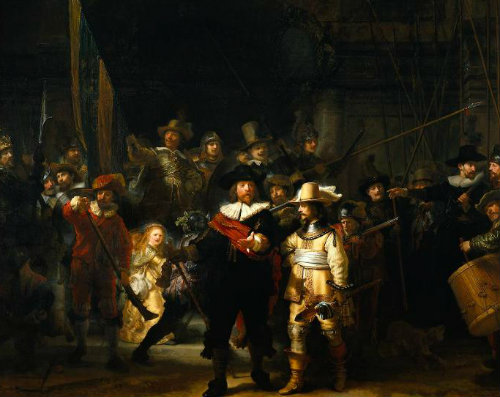
The Night Watch c.1642 one of the greatest paintings of all time
According to Art Historian
Estelle M. Hurll "Rembrandt apparently cared very little for
the nude, for the delicate curves of the body and the exquisite colors
of flesh. Yet to overbalance this disregard of beautiful form was his
strong predilection for finery. None ever loved better the play of
light upon jewels and satin and armor, the rich effectiveness of
Oriental stuffs and ecclesiastical vestments. Unable to gratify this
taste in the portraits which he painted to order, he took every
opportunity to paint both himself and his wife, Saskia, in costume.
Wherever the subject admitted, he introduced what he could of rich
detail. In the picture of Israel Blessing the Sons of Joseph, Asenath,
as the wife of an Egyptian official, is appropriately adorned with
jewels and finery. In the Sortie of the Civic Guard, Captain Cocq is
resplendent in his military regalia.
With all this fondness for pretty things, Rembrandt never allowed his
fancy to carry him beyond the limits of fitness in sacred art. The
Venetian masters had represented the most solemn scenes of the New
Testament with a pomp and magnificence entirely at variance with their
meaning. Rembrandt understood better the real significance of
Christianity, and made no such mistake. His Supper at Emmaus is the
simple evening meal of three[x] peasant pilgrims precisely as it is
represented in the Gospel. His Christ Preaching includes a motley
company of humble folk, such as the great Teacher loved to gather about
him.
It was perhaps the obverse side of his fondness for finery, that
Rembrandt had a strong leaning towards the picturesqueness of rags. A
very interesting class of his etchings is devoted to genre studies and
beggars. Here his disregard of the beautiful in the passion for
expression reached an extreme. His subjects are often
grotesque—sometimes repulsive—but always intensely human. Reading human
character with rare sympathy, he was profoundly touched by the poetry
and the pathos of these miserable lives. Through all these studies runs
a quaint vein of humor, relieving the pathos of the situations. The
picturesque costume of the old Rat Killer tickles the sense of humor,
and conveys somehow a delightful suggestion of his humbuggery which
offsets the touching squalor of the grotesque little apprentice. And
none but a humorist could have created the swaggering hostler's boy
holding the Good Samaritan's horse.
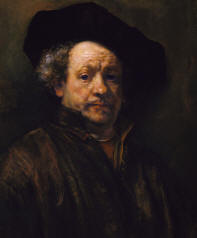
As a
revealer of character, Rembrandt reaches the climax of his power in his
portraits. From this class of his pictures alone one can repeople
Holland with the spirits of the seventeenth century. All classes and
conditions and all ages came within the range of his magic brush and
burin. The fresh girlhood of Saskia, the sturdy manhood of the Syndics,
and the storied old age of his favorite old woman model show the scope
of his power, and in Israel Blessing the Sons of Joseph he shows the
whole range in a single composition. He is manifestly at his best when
his sitter has pronounced features and wrinkled skin, a face full of
character, which he under[xi]stood so well how to depict. Obstacles
stimulated him to his highest endeavor. Given the prosaic and hackneyed
motif of the Syndics' composition, he rose to the highest point of
artistic expression in a portrait group, in which a grand simplicity of
technical style is united with a profound and intimate knowledge of
human nature."
Require more facts and information
about Artists? Poke around every nook and
cranny of the known universe for information this subject. Search
Here
If
you feel you have worthwhile information you would like to contribute
we would love to hear from you. We collect essential biographical
information and artist quotes from folks all over the globe and
appreciate your participation. When submitting please, if possible,
site the source and provide English translation. Please
submit your comment to the editor, via e-mail and if possible site the
source. Thank you!
© HistoryofPainters.com
If you like this page and wish to share it, you
are welcome to link to it, with our thanks.
copyright 2017 - historyofpainters.com