Search:: Artists Alphabetically Artists by Country Artists by Century Artists by Movement
Andrea del Verrocchio
1435-1488
One of the Greatest Painters Of All Time
Florentine Painter of the Early Renaissance
Education - apprenticed to a goldsmith Giuliano Verrocchio
Cause of Death - According to Renaissance biographer Giorgio Vasari when reminiscing about Andrea del Verrocchio untimely demise "So he mended his first model, and cast it in bronze; but he did not perfectly finish it, for being heated in casting it, he caught a chill, of which he died in a few days."
Artist Bio
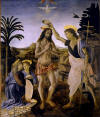
Verrocchio' s workshop was the first one in Florence where oil-painting was systematically carried on. He also guided Florence landscape painting into new paths. In contrast to the earlier Florentines, who had lost themselves in elaborate detail and caused the most distant objects to gleam in unbroken colors. Verrocchio had a taste for simple plains, which he depicted with certain plein air tendencies. His favorite hour was the twilight, when the trees stand out in black from the light grey heaven and the cool moisture sinks over withered dusty plains. But even more characteristic of the impression of his pictures is the dainty grace which he endeavors to render facial expressions and motion. While the figures of Donatello and Castigno hold their hands wide open and extend the second finger, Verrocchio merely bend the little finger -- a detail which alone is significant of the change of taste; there, energy; here, an almost effected delicacy. Noli me tangere is the inscription upon his portrait of Pippo Spano, though in a very different since. Verrocchio himself felt what a delicate, fragile ideal he substituted for the mighty, powerful figures of the older masters. He was the first to depict a dainty Christ child in place of a robust, healthy child; to give to the features of the Madonna a touch of that soft enchanting smile associated with Leonardo's name. -- Richard Muther, The History of Modern Painting, Henry and Co., London, 1896
VERROCCHIO’S LANDSCAPE PAINTING TEQNIQUES
Art
historian, Bernhard Berenson,
states
"Verrocchio the first to feel that a faithful reproduction of the
contours is not landscape, that the painting of nature is an art
distinct from the painting of the figure. He scarcely knew where the
difference lay, but felt that light and atmosphere play an entirely
different part in each, and that in landscape these have at least as
much importance as tactile values. A vision of plein air, vague I must
grant, seems to have hovered before him, and, feeling his powerlessness
to cope with it in full effects of light such as he attempted in his
earlier pictures, he deliberately chose the twilight hour, when, in
Tuscany, on fine days, the trees stand out almost black against a sky
of light opalescent grey. To render this subduing, soothing effect of
the coolness and the dew after the glare and dust of the day—the effect
so matchlessly given in Gray’s “Elegy”—seemed to be his first desire as
a painter, and in presence of his “Annunciation” (in the Uffizi), we
feel that he succeeded as only one other Tuscan succeeded after him,
that other being his own pupil Leonardo."
Classical humanism, was a major factor of the Italian Renaissance. This philosophical movement was based on the idea that every persons life had value and dignity. Humanism also stressed man's position in the natural world. The Humanists believed modern man should look to the classical writings and art of the ancient Greeks and Romans as exemplary guides for ethical living and scholarship. Francesco Petrarch,1304-1374, called the Father of Humanism, Italian Intellectual, Poet, and Humaniststated, "No one intellect should ever strive for distinction in more than one pursuit. Those who boast of preeminence in many arts are either divinely endowed or utterly shameless or simply mad. Who ever heard of such presumption in olden times, on the part of either Greeks or men of our own race? It is a new practice, a new kind of effrontery. To-day men write up over their doors inscriptions full of vainglory, containing claims which, if true, would make them, as Pliny puts it, superior even to the law of the land.. ."
During the Renascence the spirit of an era awoke, revitalized with knowledge and creativity. Although art still served a specific functions, which were primarily religious, painters added more of their individual spirit and personal vision to their creations. John Ruskin, famous art historian declared, "The art of any country is the exponent of its social and political virtues . The art, or general productive and formative energy, of any country, is an exact exponent of its ethical life. you can have noble art only from noble persons, associated under laws fitted to their time and circumstance."
The major painters of the Renaissance
were not only artists but men of great genius who gave the world their
great intellectual gifts. Florentine and Venetian painting were both
formed by extraordinary personalities. These independent creative
geniuses tackled mathematical, artistic and philosophical problems of
the highest interest, and presented solutions that have never lost
their value. The sense of humanism pervading renaissance painting is
still palpable. The painters touched on a multitude of issues
regarding the human condition - death, love, reason, religion,
universal morality, social problems.
Key Descriptive Words and Phrases associated with the Renaissance Movement - rebirth, rediscovery of the classical world, City-state, Humanism, Humanist, Francesco Petrarch, Reform, The Prince, Theocracy, The Inquisition, Human Reasoning, publication of Della Pittura, a book about the laws of mathematical perspective for artists, sfumato, chiaroscuro, linear perspective, Heliocentric Theory, vanishing point, Savonarola, spiritually significant, illuminated manuscript, idealized biblical themes, scriptorium, emotion, illuminator, iconoclast, Age of Discovery, axonometric drawing, curiosity about the natural world, mythology, realistic use of colours and light, Bonfire of the Vanities, Old Testament stories, ethereal and foggy backgrounds, Gospel parables, The Blackdeath, romanticized landscapes, Christian symbolism. Paradise
☼☼☼☼☼
Require more facts and information about the painter and the artists of the renaissance era? Poke around every nook and cranny of the known universe for information this subject. Search Here
© HistoryofPainters.com If you like this page and wish to share it, you are welcome to link to it, with our thanks.