100 Greatest Painters Artists Alphabetically Artists by Country Artists by Century Artists by Movement
And suddenly there was with the angel a multitude of the heavenly host praising God and saying, Glory to god in the highest and on earth peace, good will toward men. (Luke 2, 13 and 14)
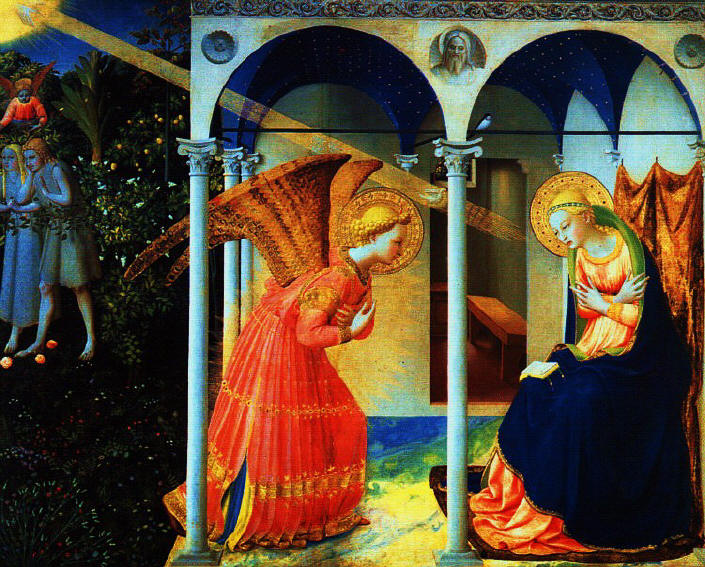
Northern Renaissance, Gothic and Early Renaissance paintings are rich in philosophical and Christian symbolism regarding angels.
The word 'angel' comes from the Greek angelos,
which stems from the Hebrew word mal'akh, which translates to
'messenger'.
Angels date back into ancient Mesopotamia. They are found on relief
carvings and resemble moth like creatures. The angle as we know it did
not surface until the Carolingian period.
According to Anna Jameson, author of Sacred
and Legendary Art, "In ancient pictures and illuminations which
exhibit the glorification of the Trinity, Christ, or the Virgin, the
hierarchies of angels are represented in circles around them, orb
within orb. This is called a glory of angels. In Pictures it is seldom
complete: instead of nine circles, the painters content themselves with
one or two circles only. The innermost circles, the Seraphim and the
Cherubim, are in general represented as heads merely, with two or four
or six wings, and of a bright red or blue color; sometimes with
variegated wings, green, yellow, violet, etc. this emblem intended to
shadow forth to human comprehension a pure spirit glowing with love and
intelligence, in which all that is bodily is put away, and only the
head, the seat of soul, and wings, the attribute of spirit and
swiftness, retained is of Greek origin. "
Popular Questions About Art History
How did African art and artifacts impact modern art?
How did Raphael die?
What was the impact of Japanese Prints on Post Immpressionist painters in the late 19th century?
What is the difference between Italian Renaissance art and Northern Renaissance art?What was the impact of the iconoclast on European art?
How did the Black Death impact European art history?
What was the influence of Classical humanism on the Renaissance?
How did the Inquisition impact European art history?
What was the influence of the Medici Academy on Renaissance painters?
How did the Bonfire of the Vanities impact Italian Renaissance"
What is Sfumato?
Who were the greatest painters of the Renaissance?
If you feel you have worthwhile information you would like to contribute we would love to hear from you. We collect essential biographical information and artist quotes from folks all over the globe and appreciate your participation. When submitting please, if possible, site the source and provide English translation. Email to historyofpainter@gmail.com

© HistoryofPainters.com 2017
This text is Copyright © historyofpainters.com. Do not use without permission. If you like this page and wish to share it, you are welcome to link to it, with our thanks.