Search:: Artists Alphabetically Artists by Country Artists by Century Artists by Movement
Giorgione
"Giorgione" means "George the Great" in Italian
1477-1510
Venetian Painter of the High Renaissance
Stylistically influenced by the following painters -Leonardo da Vinci, Fra Bartolommeo and Giovanni Bellini
Education - apprenticed to Giovanni Bellini
Cause
of Death - Plague
Biography
Giorgio Barbarelli da Castelfranco was born in a small town just outside of Venice. From an early age he exhibited extraordinary artistic abilities and was sent to Venice be trained under the legendary Renaissance master Bellini. Giorgio was a striking young man, famous for his handsomeness and strength. He earned the nickname "Giorgione" which means "George the Great" in Italian, for his physical beauty and his painting abilities. Giorgione was a master at using a newly developed painting technique called sfumato or chiaroscuro. This technique imparted a dramatic, almost dreamlike luminosity of light for which his masterpieces are famous.
According to art historian and
author, Bernhard Berenson, "Giorgione created a demand which other
painters were forced to supply at the risk of finding no favor. The
older painters accommodated themselves as best they could. One of them
indeed, turning toward the new in a way that is full of singular charm,
gave his later works all the beauty and softness of the first spring
days in Italy. Upon hearing the title of one of Catena's works in the
National Gallery, "A Warrior Adoring the Infant Christ," who could
imagine what a treat the picture itself had in store for him? It is a
fragrant summer landscape enjoyed by a few quiet people, one of whom,
in armor, with the glamour of the Orient about him, kneels at the
Virgin's feet, while a romantic young page holds his horse's bridle. I
mention this picture in particular because it is so accessible, and so
good an instance of the Giorgionesque way of treating a subject; not
for the story, nor for the display of skill, nor for the obvious
feeling, but for the lovely landscape, for the effects of light and
color, and for the sweetness of human relations. Giorgione's
altar-piece at Castelfranco is treated in precisely the same spirit,
but with far more genius.
The young painters had no chance at all unless they undertook at once
to furnish pictures in Giorgione's style. But before we can appreciate
all that the younger men were called upon to do, we must turn to the
consideration of that most wonderful product of the Renaissance and of
the painter's craft—the Portrait."
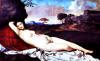
The suggestion of melancholy, perhaps also longing, is a strong theatrical element in almost all of his work. Giorgione's Pastoral Symphony, circa 1508, is one of the greatest masterpieces of the High Renaissance. The artist died of plague at the height of his fame in 1510.
Key Descriptive Words and Phrases associated with the Renaissance Movement - rebirth, rediscovery of the classical world, City-state, Humanism, Humanist, Francesco Petrarch, Reform, The Prince, Theocracy, The Inquisition, Human Reasoning, publication of Della Pittura, a book about the laws of mathematical perspective for artists, sfumato, chiaroscuro, linear perspective, Heliocentric Theory, vanishing point, Savonarola, spiritually significant, illuminated manuscript, idealized biblical themes, scriptorium, emotion, illuminator, Age of Discovery, axonometric drawing, curiosity about the natural world, mythology, realistic use of colours and light, Bonfire of the Vanities, Old Testament stories, ethereal and foggy backgrounds, Gospel parables, The Blackdeath, romanticized landscapes, Christian symbolism. Paradise
☼☼☼☼☼
Require more facts and information about the painter and the artists of the renaissance era? Poke around every nook and cranny of the known universe for information this subject. Search Here
© HistoryofPainters.com If you like this page and wish to share it, you are welcome to link to it, with our thanks.