100 Greatest Painters Artists Alphabetically Artists by Country Artists by Century Artists by Movement
The
Color Blue -
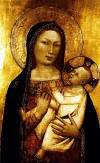
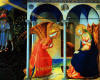
symbolizes purity; The Virgin Mary; Virgin and Child; The Immaculate
Conception
The White Lily - a
flower used as the emblem of the Virgin; the white color of the petals
stand for the purity of her body and the golden anthers the radiance of
her soul.
The Rose -
a flower which was used as the emblem of Mary's love of God.
The
Color Gold used
as a background
color or
in the halo symbolizes purity, royalty and glory of life
after death.
Candor Illaesus 'Unadulterated
Whiteness' emblem of the Incarnation, this symbol pays tribute to the
purity and sinlessness of the Blessed Virgin.
The Color White - is a
sign of innocence; Birth, Youth, Betrothal and Marriage; The Virgin
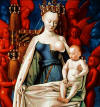
Mary; Virgin and Child; The Immaculate Conception, The Holy Family The Crown worn
by Mary of
being presented to her by angels or some other holy figure. The
crown is
symbolic of supremacy, authority, immortality, morality, exultation,
triumph, rebirth, and grandeur.
The Three Fibula (a
fibula is a type of golden bejeweled ancient brooch), depicted on the
Virgin's shoulders and forehead found on Byzantine era icons, represent
her chastity before, during and after being with the birth of Jesus
Christ.
A Sieve is
a symbol of virginity and purity dating back to antiquity and was used
since the Middle Ages to glorify the Blessed Virgin.
Pink - symbolizes eternal innocence; The Virgin Mary; Virgin and Child; The Immaculate Conception
The Virgin Mary in Art History
During the Carolingian period, Mary had usually been represented alone with arms raised in prayer. More rarely the theme was the Madonna with the Christ child, although, according to legend, the evangelist Luke had painted such a picture. For artists of this era, the Christian gospel of the renunciation of earthly things was determinative. The eyes of there chaste and pale faces do not long for earthly pleasures, but gaze, foreboding future suffering, wit melancholy piety into the infinite. In this resignation and perfect renunciation of all earthly joys, they embody the ethical content, the innermost spirit of Christianity.
According to art historian Richard Muther "The Virgin Mary was central to Byzantine Art. The youthful mother of God, became the centre of worship. The adoration of Mary reflected in part the knightly reverence for woman felt by the Crusaders and the Minnesingers; but it is also due to her personality, which, in its tender, helpless womanhood, was more sympathetic to the sentiment of the age than the tragic figure of the Son of God and the severe majesty of the Father.
It is not until the close of the thirteenth century, in the works of Florentine master Cimabue, is a change perceptible. The Christ-child becomes more childish and tender; and a soft inclination of the head of the Madonna shows that she hears prayers of men and can bring them help and gracious forgiveness. The hard, sullen features are animated by softness and charm, by human sentiment; and it is in this sense Vasari wrote that through Cimabue more live had come into art."
Early Sienese painters were the first to endow Mary with mysticism and a dreamy sentimentality. The Virgin Mary is frequently shown holding an open book, symbolic of her submission to Gods Holy Law. Sienese Madonna's are the most mystical and beguiling in the history of art.In Botticelli's The Madonna and Child with an Angel, 1468 (housed in Spedale degli Innocenti of Florence). The Madonna looks thoughtfully upon the crown of thorns and the nails, which the Christ-child innocently, unsuspectingly holds, a curly haired angel offers her grapes and ears of wheat, the symbol of sacrifice. In the place of the fresh worldliness of Fra, Fillippo, Botticell's works reveal the presence of a mystic and transcendental, a solemn and sacramental element. While the realists in their Madonna's portray the joys of motherhood, Botticelli's know no joy whatever. Mary appears gloomy and lost in thought, as if, even when she presses the Christ-child to her bosom, a foreboding of coming suffering casts its shadow over her soul. Richard Muther, The History of Modern Painting, Henry and Co., London, 1896
In Titian's Assumption of the Virgin (Assunta). 1516-1518, Mary as if drawn by a celestial magnet, her mighty arms outstretched, ascends towards heaven. Her dark hair flutters in the wind, the folds of her garments swell grandiosely, and a roar like the moving of angels wings of the archangels soundly through the air; astonished, the apostles stretch their arms upward. Richard Muther, The History of Modern Painting, Henry and Co., London, 1896
In the Church of the Frari, the most important Venice church after the Basilica of St. Mark's, in Titian's exquisite Pesaro Madonna, one first recognizes the dramatic action which Titian brought to Venetian art. Mary sits; not in the center of the painting, nor even in full-face, as Byzantine tradition demanded. The principles of composition of the past are deserted; the lines are not arranged in regular architectonic order; a composition which reckons only colored masses takes the place of regular arrangements. Richard Muther, The History of Modern Painting, Henry and Co., London, 1896
According to the Holy Church "All the signs in the liturgical celebrations are related to Christ: as are sacred images of the holy Mother of God and of the saints as well. They truly signify Christ, who is glorified in them. They make manifest the "cloud of witnesses"29 who continue to participate in the salvation of the world and to whom we are united, above all in sacramental celebrations. Through their icons, it is man "in the image of God," finally transfigured "into his likeness,"30 who is revealed to our faith. So too are the angels, who also are recapitulated in Christ"
Popular Questions About Art History
How did African art and artifacts impact modern art?
How did Raphael die?
What was the impact of Japanese Prints on Post Immpressionist painters in the late 19th century?
What is the difference between Italian Renaissance art and Northern Renaissance art?What was the impact of the iconoclast on European art?
How did the Black Death impact European art history?
What was the influence of Classical humanism on the Renaissance?
How did the Inquisition impact European art history?
What was the influence of the Medici Academy on Renaissance painters?
How did the Bonfire of the Vanities impact Italian Renaissance"
What is Sfumato?
Who were the greatest painters of the Renaissance?
If you feel you have worthwhile information you would like to contribute we would love to hear from you. We collect essential biographical information and artist quotes from folks all over the globe and appreciate your participation. When submitting please, if possible, site the source and provide English translation. Email to historyofpainter@gmail.com

© HistoryofPainters.com 2017
This text is Copyright © historyofpainters.com. Do not use without permission. If you like this page and wish to share it, you are welcome to link to it, with our thanks.