Search:: Artists Alphabetically Artists by Country Artists by Century Artists by Movement
Bernardo Daddi
1290-1348
Italian, Florentine, Early Renaissance Painter
Stylistically influenced by the following painters - Pietro Lorenzetti, Giotto and Maso di Banco
Education - apprenticed to Giotto
Cause of Death - The Great Plague of 1348
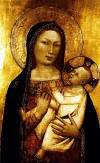
One of the Greatest Painters Of All Time
Biography Information and Facts About the Artist
Bernardo Daddi was one of the most original and imaginative Early Renaissance painters working in Italy. His secret lies in the flow of line, the clear arrangements of groups, and the meticulous attention to detail. In order that the luminousness of his presentation might not suffer, he avoids all unnecessary ornament, confining himself to the spiritual content of his theme. Although he painted mystical subjects, he was known among his contemporizes as a down to earth man who possessed a wonderful character.
Daddi's greatness derives from eclecticism and the spirit of humanity that saturate his paintings. The Christ figure shimmers on the cross glorious against a background of gold, creating a mood of wonderment and mystery. His sensitive, lyrical style and ethereal-looking holy figures generated steady, lucrative commissions until his untimely death of the plague in 1348. He is considered one the greatest Early Renaissance painters of all time.
Beginnings of the Renaissance
At the closing of the fourteenth century there was an awakening of the senses. Italy felt the awakening earlier than the rest of Europe, and felt it far more powerfully. Its first manifestation was a limitless and unquenchable curiosity, urging people to find out all they could about the world and about man. They looked around them at the amazing building that still stood, the Roman forum, the coliseum and realized that something truly great had preceded them. People turned enthusiastically to the study of classic literature and ancient civilizations. They were inspired by the vast store-house of long forgotten knowledge of antiquity. Walter Pater observed "No account of the Renaissance can be complete without some notice of the attempt made by certain Italian scholars of the fifteenth century to reconcile Christianity with the religion of ancient Greece. "
The newly emerging painting techniques and styles were a reflection of the transformation that was taking place in Europe, the change from the medieval period to a more enlightened, tolerant society. Artists, writers and scholars were flourishing. Great states were being created. Large centers of commerce were being founded. High above the turreted towers of the castle and the peaked roof of the town-hall, rose the slender spire of the newly built Gothic cathedral. Everywhere the world was in transition. The newly wealthy merchant class, was becoming conscious of their own strength and were struggling to throw off the yoke of their feudal masters.
Key Descriptive Words and Phrases associated with the Renaissance Movement - rebirth, rediscovery of the classical world, City-state, Humanism, Humanist, Francesco Petrarch, Reform, The Prince, Theocracy, The Inquisition, Human Reasoning, publication of Della Pittura, a book about the laws of mathematical perspective for artists, sfumato, chiaroscuro, linear perspective, Heliocentric Theory, vanishing point, Savonarola, spiritually significant, illuminated manuscript, idealized biblical themes, scriptorium, emotion, illuminator, Age of Discovery, axonometric drawing, curiosity about the natural world, mythology, realistic use of colours and light, Bonfire of the Vanities, Old Testament stories, ethereal and foggy backgrounds, Gospel parables, The Blackdeath, romanticized landscapes, Christian symbolism.
☼☼☼☼☼
Famous
Quotes From Painters of the Renaissance Art Era
quote
The
painter has the Universe in his mind and hands. Leonardo da
Vinci quote
I
saw the angel in the marble and carved until I set him free. Michelangelo
Require more facts and information about artists of the renaissance era? Poke around every nook and cranny of the known universe for information this subject. Search Here
© HistoryofPainters.com If you like this page and wish to share it, you are welcome to link to it, with our thanks.