Search:: Artists Alphabetically Artists by Country Artists by Century Artists by Movement
Coppo di Marcovaldo
1225-1274
Founder of the Sienese School
Florentine Italian Painter in the Byzantine Tradition
Education - apprenticed at age 10 to local Greek icon makers and later a gold smith
Medium - Tempera and gold leaf on wood
Cause of death - unknown
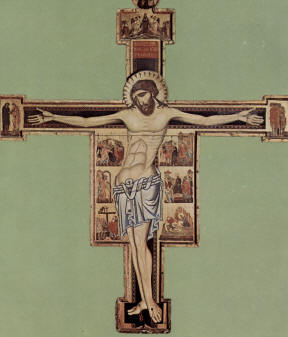
Coppo di Marcovaldo was the Michelangelo of his day. Famous for his Christian-themed painted icons with ecclesiastical figures often hovering above the Virgin Mary. Coppo di Marcovaldo started life as a hard drinking soldier in the army of Florence. The weary young veteran establish a home and studio in Siena after he was imprisoned following the bloody Battle of Montaperti.
The
brilliant artist was in great demand for his aesthetically pleasing
masterpieces. The church commissioned religious images for alter
pieces and interior paintings on panel.
Accoding to author and art
historian Clive bell "Art and religion belong to the same world. Both
are bodies in which men try to capture and keep alive their shyest and
most ethereal conceptions. The kingdom of neither is of this world.
Rightly, therefore, do we regard art and religion as twin
manifestations of the spirit; wrongly do some speak of art as a
manifestation of religion." Coppo di Marcovaldo' s paintings
became prized for their inventive compositions and immense
beauty. His style was typified by a certain poetical
tenderness, combined naturalistic element with the fantastic
religious fervor typical of the Byzantine painting tradition.
Most prominently featured in his work are the holy figures of
the Christian faith---Christ, Saints, The Cross, Virgin
Mary, Chalice, Keys, The Anchor, Wheat , The
Good Shepherd, The
Apostles, Animals,Fish, Angels, Birds, Insects
and Satan.
Until the Middle Ages men regarded themselves as following the Good Shepherd, and art consequently did not recognize the individual in particular. In the structure and position of the figures, as in their expression, a general and uniform type of beauty prevailed. The early Renaissance marks the victory of individualism and the uncompromising prominence of he individual. According to Renaissance historian Walter Pater "Here, artists and philosophers and those whom the action of the world has elevated and made keen, do not live in isolation, but breathe a common air, and catch light and heat from each other’s thoughts. There is a spirit of general elevation and enlightenment in which all alike communicate. The unity of this spirit gives unity to all the various products of the Renaissance; and it is to this intimate alliance with the mind, this participation in the best thoughts which that age produced, that the art of Italy in the fifteenth century owes much of its grave dignity and influence.."
Renaissance Art Characteristics and Key Descriptive Words and Phrases associated with the Renaissance Movement - rebirth, rediscovery of the classical world, City-state, Humanism, Humanist, Francesco Petrarch, Reform, The Prince, Theocracy, The Inquisition, Human Reasoning, publication of Della Pittura, a book about the laws of mathematical perspective for artists, sfumato, chiaroscuro, linear perspective, Heliocentric Theory, vanishing point, Savonarola, spiritually significant, illuminated manuscript, idealized biblical themes, scriptorium, emotion, illuminator, Age of Discovery, axonometric drawing, curiosity about the natural world, mythology, realistic use of colours and light, Bonfire of the Vanities, Old Testament stories, ethereal and foggy backgrounds, Gospel parables, The Blackdeath, romanticized landscapes, Christian symbolism.
☼☼☼☼☼
Require more facts and information about the painter and the artists of the renaissance era? Poke around every nook and cranny of the known universe for information this subject. Search Here
© HistoryofPainters.com If you like this page and wish to share it, you are welcome to link to it, with our thanks.