Search:: Artists Alphabetically Symbolism 50 Greatest Paintings Art Movements
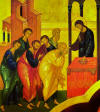
Paintings of Jesus with the Apostles (click to enlarge)
The Apostles began showing up on the walls of the catacombs beginning within the 1st and 2nd centuries. In early Christian paintings sacred themes were initially expressed in visual symbols. This is because the first Christians feared torture or a stint in the arena if they flaunted their religion openly. With the fall of the Roman empire and Christianization of Europe artists of the Migration and Carolingian period depicted Madonna's, the Apostles and Christ in illuminated manuscripts, mosaics and frescos. Origen Adamantius, an early Christian theologian stated "If all things were made through Him, clearly so must the splendid revelations have been which were made to the fathers and prophets, and became to them the symbols of the sacred mysteries of religion." The Byzantine era was Christian art at its zenith. In Western Art the depiction of Twelve sheep symbolized the Twelve Apostles. Early Renaissance masters such as Bernardo Daddi, and Giotto became prized by the church and feudal courts for their compositional unity and mystical intensity.
Apostles and Saints were often shown with open books. Saint Augustine (354-430) was regularly depicted sitting at his desk with an open heart-shaped book, symbolic of his passion for truth and reverence for the Word of God, the ultimate source of light and truth.
The Spiritual Illuminators of the World
Regarding the life and occupations of the Apostles
prior to their life with Jesus , W.D. Killen writes" All the Twelve,
when enlisted as disciples of Christ, appear to have moved in the
humbler walks of life; and yet we are scarcely warranted in asserting
that they were extremely indigent. Peter, the fisherman, pretty plainly
indicates that, in regard to worldly circumstances, he had been, to some
extent, a loser by obeying the call of Jesus. Though James and
John were likewise fishermen, the family had at least one little vessel
of their own, and they could afford to pay "hired servants" to assist
them in their business. Matthew acted, in a subordinate capacity,
as a collector of imperial tribute; but though the Jews cordially hated
a functionary who brought so painfully to their recollection their
condition as a conquered people, it is pretty clear that the publican
was engaged in a lucrative employment. Zacchaeus, said to have been a
"chief among the publicans," is represented as a rich man; and Matthew, though probably in an inferior station, was able to give an
entertainment in his own house to a numerous company. Still,
however, the Twelve, as a body, were qualified, neither by their
education nor their habits, for acting as popular instructors; and had
the gospel been a device of human wisdom, it could not have been
promoted by their advocacy. Individuals who had hitherto been occupied
in tilling the land, in fishing, and in mending nets, or in sitting at
the receipt of custom, could not have been expected to make any great
impression as ecclesiastical reformers. Their position in society gave
them no influence; their natural talents were not particularly
brilliant; and even their dialect betokened their connection with a
district from which nothing good or great was anticipated. But
God exalted these men of low degree, and made them the spiritual
illuminators of the world."
The 12
Apostles
Andrew
Bartholomew
James the Great of Compostella
James the Less
John
Judas Iscariot
Jude (Thaddeus)
Matthew (Levi)
Matthias
Paul
Philip
Simon
Thomas
The Meaning of Sacred Symbols in Paintings. Most prominently featured symbols and their meaning:
☼☼☼☼☼
Require more facts and information about the Apostles in Art history? Poke around every nook and cranny of the known universe for information this subject. Search Here
If you feel you have worthwhile information you would like to contribute we would love to hear from you. We collect essential biographical information and artist quotes from folks all over the globe and appreciate your participation. When submitting please, if possible, site the source and provide English translation. Please submit your comment to the editor, via e-mail and if possible site the source. Thank you!
copyright 20003 - historyofpainters.com
© HistoryofPainters.com If you like this page and wish to share
it, you are welcome to link to it, with our thanks.
References - The Ancient
Church Its History,
Doctrine, Worship, and
Constitution by William
Dool Killen