Search:: Artists Alphabetically Artists by Country Artists by Century Artists by Movement
Jan van Eyck
1395-1441
One of the Greatest Painters Of All Time
Early Northern
Renaissance, Flemish Painter, founder
of the Bruges school
Stylistically influenced by the following painters; Melchior Broederlam, Hubert van Eyck, and Robert Campin
Cause of death: White Plague - Tuberculosis
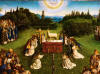
'The Adoration of
the Lamb', click to enlarge
Jan Van Eyck was a good-natured artist with a curious nature. In his art every brush stroke is as keen and biting as a sharp knife. He was always creating; rethinking problems, and breaking new ground as an artist. Everyone who came in contact with him admired his intellect and engaging wit. Ghent was In the 15th century was one of the creative epicenters in Northern Europe. The prosperous town was leading the way in learning, architecture, painting, ironworks, literature and commerce. Jan Van Eyck was at the top of the heap. Author Walter M. Gallichan describes the greatest masterpeice in Ghent, "The masterpiece here is “The Adoration of the Lamb,” the marvellous altar-picture painted by Jan and Hubert Van Eyck. The colour is glowing, though the picture was painted in 1432. The Lamb is attended by angels, and worshipped by a company of the devout. There are hundreds of heads in the composition, which has several compartments. The landscape is exquisitely rendered, both in the effect of distance and in the flowers of the foreground. Parts of the altarpiece are elsewhere, in Berlin and Brussels, and the whole was carried away by the French, only a portion being restored. Portraits of the brothers Van Eyck are among the Just Judges in the picture."
Author Walter M. Gallichan describes Ghent in the time of Jan Van Eyck, "Ghent was early a stronghold of powerful trade guilds, and one of the meeting-places of these unions was in the Market Square. These organisations of craftsmen were probably established first by the Flemish weavers to protect the woollen industry. All over Europe the guilds were instituted by artisans working in walled towns during the Middle Ages. Chaucer mentions them in England in his day. The guilds had their masters or wardens, who exercised an almost despotic sway over the members, and watched their interests zealously.
In a time where the average peasant was lucky
to receive a bowl of thin gruel and crust of bread for a hard days
work, Van Eyck lived high on the hog. He regularly dined on stuffed
pigeons (a delicacy way back then), caviar, extravagantly made cakes
and imported liquors. The artist was paid enormous sums for
his incredible paintings and lived a lavish lifestyle. Jan
van Eyck was not concerned with painting suffering or misery; his
masterpieces appealed only to the wealthier classes, who required of
art a feast for the eye but no spiritual emotion. With him everything
is delicate and bright; the flowers are in bloom, jewels sparkle, and a
idyllic atmosphere pervades his world.
According to art historian Clara Erskine Clement "Jan van Eyck was something of a diplomat as well as a painter, for when he was in the service of Philip the Good, Duke of Burgundy, he was sent on several secret missions, and in 1428 he accompanied the ambassadors of the duke to Portugal in order to paint the portrait of Isabella of Portugal, who was betrothed to the duke. There is a goodly number of works by Jan van Eyck in various galleries. The portrait of himself and wife in the National Gallery, London, is very interesting; they stand hand in hand, with a terrier dog at their feet; their dress and all the details of their surroundings are painted with great care. It is said that the Princess Mary, sister of Charles V., gave a barber who owned it a position with a handsome salary in exchange for the picture. Jan van Eyck, being twenty years younger than his brother Hubert, naturally learned all that the elder knew, and the story of his life gives him the appearance of being the more important artist, though in point of highest merit he was not the superior."
The four main technical differences that set the Northern painters apart is the use of superior paints, painting from direct observation, detailed realism and empirical perspective. The prevailing characteristic of Van Eyck's work being slender, supple grace. In his Arnolfini Portrait panel, The couple are noble and dignified, but temperate and gracious. The palette is lush, characterized by warm hues of brown, powerful reds, moss greens, gauzy yellows and muted grays. Like all great painters of his day an Van Eyck was a master of Biblical symbolism. William H. Hunt asserted "When language was not transcendental enough to complete the meaning of a revelation, symbols were relied upon for heavenly teaching, and familiar images, chosen from the known, were made to mirror the unknown spiritual truth." Van Eyck explored in his own art a new world of mathematically precise perspective but also emotion and passion. He was drawn to both the natural and spiritual realm.
Differences Between Northern Renaissance and Italian Renaissance Art
The four main technical differences that set the Northern Renaissance painters apart from Italian Renaissance painters is their use of superior paints, painting from direct observation, detailed realism and empirical perspective. Many of the early paintings of the Northern Renaissance perished through time and the fierceness with which the Iconoclastic battles were waged. The Northern Renaissance was different from the Italian Renaissance in many ways. Painters of the North focused upon secular society rather than the Church and overblown religious themes. Northern Renaissance painters emphasis the daily life of the merchant and peasant class. They also put a greater emphasis on spirituality, piousness and living a simple life. Artists such as Dieric Bouts and Peter Brugal the Elder painted inspirational biblical scenes, the merchant class at work, idyllic scenes of peasants working at everyday tasks, playing games and feasting. Oil paint was invented by Northern Renaissance painters. According to art historian John C. Van Dyke "The chief medium was oil, used upon panel or canvas. Fresco was probably used in the early days, but the climate was too damp for it and it was abandoned. It was perhaps the dampness of the northern climate that led to the adaptation of the oil medium, something the Van Eycks are credited with inaugurating."The Italian Renaissance, on the other hand, focused more on the aristocracy and the theocracy. Painters highlighted the individual and glorified worldly pleasures, Paintings were sumptuous, elaborate, expressive, and exhalted wealthy and powerful people. Author Clive Bell observed "But whatever the Italian painters of the Renaissance had to say they said in the grand manner. Remember, we are not Dutchmen. Therefore let all your figures suggest the appropriate emotion by means of the appropriate gesture—the gesture consecrated by the great tradition. Straining limbs, looks of love, hate, envy, fear and horror, up-turned or downcast eyes, hands outstretched or clasped in despair."
The Italian Renaissance painters focused heavily on religion, Roman Catholicism. Popes and church hierarchy were wealthy, powerful rulers. Like kings they were depicted in elaborate settings swaddled in furs and silks.
Important Words, People, Phrases, Characteristics related to the Northern Renaissance Art Movement - allegorical painting, rebirth, invention of oil painting, Hieronymus Bosch, Limbourg Brothers, Desiderius Erasmus, Robert Campin, Jan Van Eyck, Jean Fouquet, Albrecht Dürer, Johannes Gutenberg, Johann Reuchlin, Martin Luther, rise of the merchant class, Protestant Reformation, Calvinisim, glazing, impasto, scriptorium, illuminator, invention of the printing press, woodcuts, engravings, Antwerp School, Guild of Saint Luke, commerce, Flemish School, Northern Europe, Antwerp School, Flanders, Bruges, renewed interest in classical learning, mythological scenes, genre painting, landscapes, portraits, moralizing overtones, human vices, lust, paradise, spirituality, piousness, living a simple life, reform, Human Reasoning, tradesmen at work, idyllic scenes of peasants, playing games, feasting, linear perspective, \Heliocentric Theory, humour, satire, spiritually significant, illuminated manuscript, idealized biblical themes, scriptorium, emotion, illuminator, iconoclast, Age of Discovery, Virgin and Child, axonometric drawing, curiosity about the natural world, realistic use of colours and light, Old Testament stories, Gospel parables, The Blackdeath, Christian symbolism
Require more facts and information about Jan van Eyck and Art history? Dig around every nook and cranny of the known universe for information this subject. Search Here
☼☼☼☼☼
© HistoryofPainters.com If you like this page and wish to share it, you are welcome to link to it, with our thanks. updated 3/7/2017